Problem Statement
An automotive company eyeing to launch an Electric Vehicle for their audience to curb the competition & sustain in the market as well as to be environmentally friendly reasons like the greenhouse effect, plus low-cost maintenance & high performance for the users.
Pain points
- Database | Error-prone process using Excel as spreadsheets that are manually uploaded to the database.
- Website | Inconsistencies between what customers see online and what Dealers see in their Ordering System.
The impact of pain points — Business | Prevents us from selling cars online, or feeding a customer’s design directly into the Ordering System at a Dealership.
Stakeholders & their respective roles
- Design Engineers define Engineering Specs for each model which define the parts needed to build each of the various models + which can be discarded.
- Web Analysts manually manage via a set of Excel spreadsheets that drive the website Car Configuration Engine (which is quite similar to the Vehicle Builder) with customer-facing product data, prices, and configuration rules.
- Marketing Analysts subsequently overlay these Engineering Specs (which define what ‘can be built’) with Marketing Specs which define the subset of ‘what will be sold’, i.e. the definition of which models will be sold in which market and which options are available in each market.
- Product Consultant to be a SPOC between both parties leading towards execution.
User Personas
- Market Analysts
- Web Analysts
- Car Dealer
- Car buyer
- Car Manufacturer
Control Systems & its goals
Engineering Spec Management System (bespoke application based on an Oracle DB maintained by a heavily waterfall oriented)
Marketing Analysts subsequently overlay these Engineering Specs (which define what ‘can be built’) with Marketing Specs which define the subset of ‘what will be sold’, i.e. the definition of which models will be sold in which market and which options are available in each market.
Prices are defined in the SAP ERP system.
All three feed into Vehicle Builder, which is the core system of our business, basically a rules engine that informs the Dealers’ Ordering System Engineering Spec to the Factory System which schedules and handles the manufacturing of the car.
Goals / To-Do (recommendation)
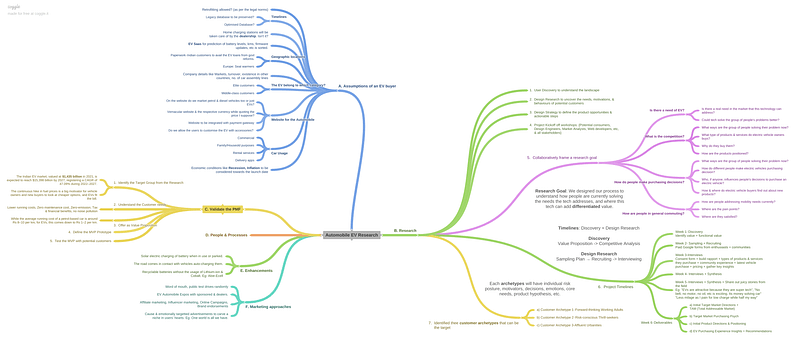
- User Discovery to understand the landscape
- Design Research to uncover the needs, motivations, & behaviors of potential customers
- Design Strategy to define the product opportunities & actionable steps
- Project Kickoff off workshops: {Potential consumers, Design Engineers, Market Analysts, Web developers, etc, & all stakeholders}
- Collaboratively frame a research goal.
- Test the Product Market Fit.
Process
- Discussion between Design Engineer & Market Analysts in the making of Spec Management System.
- Discussion between Market Analysts & developers when inputting price values into the SAP ERP system.
- Once all the disagreements are resolved, the Vehicle Builder to be built with the building blocks.
- The design team builds the responsive content-driven website which fetches data from the building blocks earlier resolved i) Spec Mgmt system ii)Marketing Specs & iii) SAP ERP system for the prices with a CRM for the website (instead of static website) to update the stock, description, generating reports, fetching feedback from the dealership + supporting payments
- This way, both the dealership + public users can view the deliverables, view the color options, the nearest dealership for a test drive, book a test drive, and place an order based on the preferences via the website to conclude with the payment transaction.
- The CMS will have the CRUD operation for entering the new supplies of the parts, engineering specs edit on what can be built & what parts suggested by design can be dropped due to feasibility.
- A Public Website website + reflecting from CMS
- Reports in the CMS help the team understand the business better
Deliverables from SPOC — User stories for all three teams, communicating blockers & resolving them, following scrum/waterfall ceremonies, estimation of tasks via Planning Poker from the tech team, ensuring the code is reviewed by the tech architect, tested thoroughly by the QA, with incremental releases leading towards the final product.
 Prathima's Miles & Milestones
Leave a comment